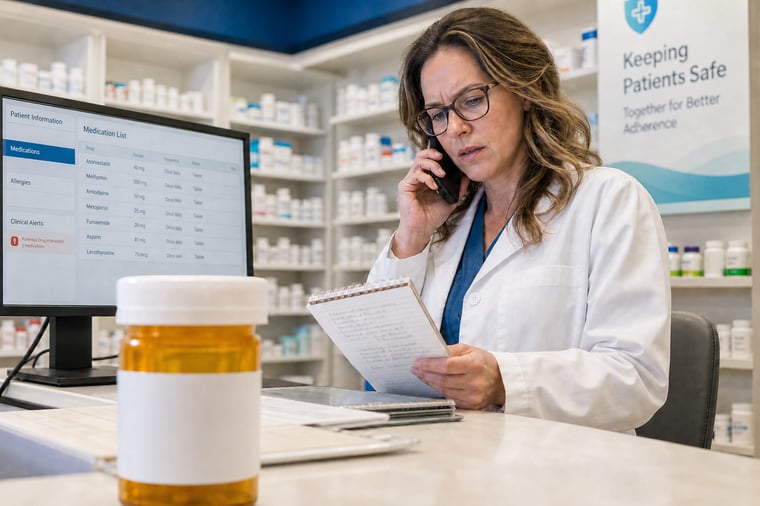
Most medication adherence work happens quietly. A member fills a prescription on time, or a simple reminder call can make all the difference. Then, nobody thinks twice about it.
But adherence data alone cannot catch everything. It cannot tell you when two prescribers, unaware of each other, put a member on a dangerous drug combination. It cannot flag a dosing error before it reaches the patient.
Those are patient safety issues, and catching them takes a pharmacist paying close attention, asking the right question, and following up until the answer makes sense.
At ActualMeds, that is another place that our team shines, and where we help members more than most.
Here are three examples:
When Two Prescriptions Should Never Have Met
A routine follow-up call uncovered something more serious. The member was taking both Entresto and Lisinopril, two medications that should never be combined. Two different prescribers had sent the prescriptions to two different pharmacies, so the conflict had gone unnoticed.
Our pharmacist reached out to the member's PCP directly. The provider confirmed the member should only be on Entresto and should have stopped the Lisinopril already. The prescriber corrected the record, and our team counseled the member on the change, so she understood exactly what to take and why.
Nobody flagged this until someone asked the right question at the right time. That question kept a member safe.
When a Dosing Error Slips Through
A pharmacy claim kept getting rejected for a metformin refill. Our pharmacist looked closer and found the new prescription called for 2,000 mg twice a day, four times the member's usual dose and well above the recommended daily limit.
She called the prescriber's office and walked through the numbers with the nurse. The prescriber called back with an admission: the dose had been entered in error. The correct prescription, 1,000 mg twice a day, was sent that same day.
A rejected claim is often treated as a routine fix. This time, it stopped a serious overdose before it reached the member.
When a Hospital Stay Leaves Loose Ends
During a follow-up call, our team discovered a member had active fills for both losartan and lisinopril. Her medications had been changed during a recent hospital stay, and the switch had not been reconciled.
Our clinician worked with the PCP to confirm the correct medication and get the outdated prescription discontinued, closing a gap that could have led to duplicate therapy or a missed dose. While speaking with the member's caregiver, our clinician also learned about ongoing insurance billing issues tied to the member's hospital and rehab stay. That same day, our team contacted the plan and got the billing concerns resolved.
One call solved two problems that had been weighing on the family: a medication risk and a financial one.
What Ties These Stories Together
None of these issues would have shown up in a standard adherence report. They are about fills but also much more than fills. They surfaced because a pharmacist or clinician looked past the immediate task, asked what else might be going on, and stayed on the call until the member was truly taken care of.
That is patient safety in practice. This is pharmacist-led medication adherence in action. It is not a policy or a checklist. It is a team willing to dig deeper and help members with whatever is standing in their way, medical or otherwise.
If your plan is looking for a partner who brings this same depth of expertise and care to your highest-risk members, we would love to talk. Contact us today to get started.